
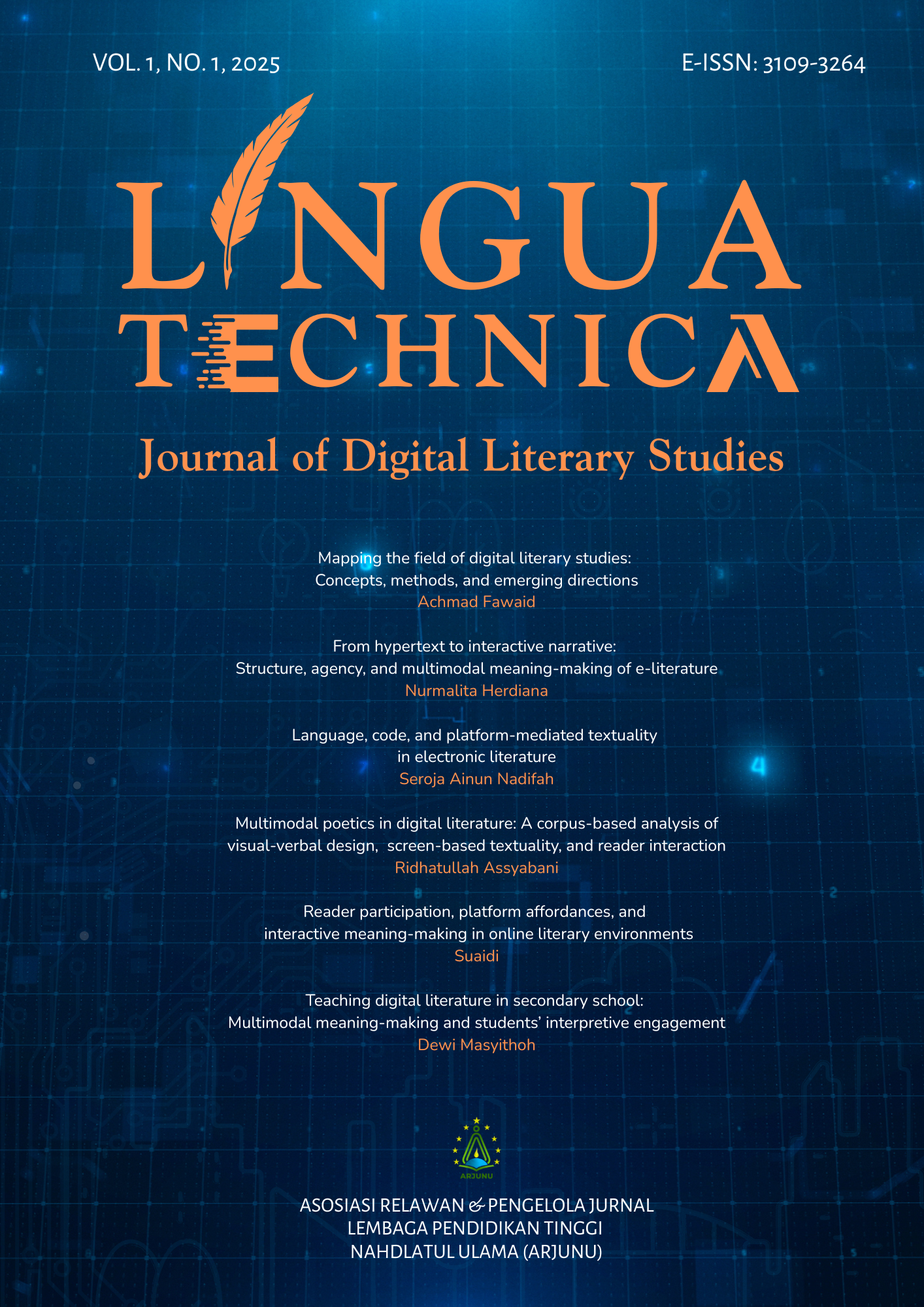
Teaching digital literature in secondary school: multimodal meaning-making and students’ interpretive engagement
DOI:
https://doi.org/10.64595/lingtech.v1i0.148Keywords:
digital literature, literary learning, multimodal discourse, reader-response, TPACKAbstract
Background: The growing use of digital platforms in secondary education has changed how literature is accessed, discussed, and produced, yet many classroom practices still treat technology mainly as a tool for distributing materials rather than as part of literary meaning-making. Objective: This study aims to examine how digital literature is taught in one public senior high school in East Java. Method: Using a qualitative case study design, this research analysed lesson documents, teaching materials, selected digital literary texts, classroom observations, platform interactions, student reflections, creative products, teacher interviews, selected student interviews, and assessment artefacts through TPACK Analysis, Multimodal Discourse Analysis, and Reader-Response Analysis. Results: The findings show that technology integration was uneven: Google Classroom, Padlet, Canva, mobile phones, online texts, and projection media supported access, discussion, reflection, and production, but lesson objectives and assessment rubrics still relied heavily on print-based literary categories. Digital literary texts expanded meaning-making through verbal, visual, auditory, spatial, kinetic, interactive, and platform-based modes. Implication: Students demonstrated strong affective, social, and creative engagement, especially through digital poems, visual stories, posters, and video responses, but they experienced difficulty with hyperlinks, non-linear narration, interface structures, and multimodal coherence. Novelty: The novelty of this study lies in proposing a corpus-based classroom framework that connects TPACK, multimodal discourse, and reader-response perspectives to examine digital literature as instructional design, textual form, and student reading experience.
Downloads
References
AlFaruque, S., Sultana, S., Rastogi, R., & Jabeen, Z. (2022). Integrating Literature with Technology and Use of Digital Tools: Impact on Learning Outcomes. World Journal of English Language. https://doi.org/10.5430/wjel.v13n1p278
Aliagas, C., Correro, C., & Fittipaldi, M. (2024). Digital Fiction in Literary Education: What do secondary-school teachers think about this multimodal artform as a pedagogical resource? L1-Educational Studies in Language and Literature, 24(3), 1–27.
Bennis, M. (2024). Teaching Literature in the Digital Age: Some Theoretical Reflections. International Journal of Language and Literary Studies. https://doi.org/10.36892/ijlls.v6i3.1747
Caramay, M. J., Maningas, R., Yazon, A., Manaig, K., & Tesoro, J. (2023). Lived Experiences of English Literature Teachers in A Digitalized Classroom: A Phenomenological Study. Journal of English as A Foreign Language Teaching and Research. https://doi.org/10.31098/jefltr.v3i2.1695
Iskarna, T. (2023). Alternative Models of Electronic Literary Criticism: Intermedial and Ergodic. Journal of Language and Literature. https://doi.org/10.24071/joll.v23i1.5946
Mustofa, A., & Lestari, L. (2023). LITERARY CRITICISM IN THE DIGITAL AGE: ADDRESSING THE PROBLEMS AND OPPORTUNITIES OF DIGITAL LITERATURE IN EFL PEDAGOGY. English Review: Journal of English Education. https://doi.org/10.25134/erjee.v11i1.7137
Norman, A. (2023). Educational technology for reading instruction in developing countries: A systematic literature review. Review of Education. https://doi.org/10.1002/rev3.3423
Saputra, D., Yonanda, D., Yuliati, Y., & Haryanti, Y. D. (2024). THE EFFECTIVENESS OF DIGITAL TEACHING MATERIALS TO IMPROVE LITERARY LITERACY SKILLS IN PRIMARY SCHOOLS. Jurnal Cakrawala Pendas. https://doi.org/10.31949/jcp.v10i3.10384
Sastre, M. S., & Garcia, E. F. (2022). From Text on Paper to Digital Poetry: Creativity and Digital Literary Reading Practices in Initial Teacher Education. Frontiers in Psychology, 13. https://doi.org/10.3389/fpsyg.2022.882898
Shamshul, I. S. M., Ismail, H. H., & Nordin, N. (2024). Using Digital Technologies in Teaching and Learning of Literature in ESL Classrooms: A Systematic Literature Review. International Journal of Learning, Teaching and Educational Research. https://doi.org/10.26803/ijlter.23.4.10
Thapliyal, P., & Professor, Asst. (2023). Digital Literacy and Its Impact on the Inclination towards English Literature: An Analytical Study. Turkish Online Journal of Qualitative Inquiry. https://doi.org/10.52783/tojqi.v11i2.9993
Vanathi, A. (2023). Exploring Literary Studies through Digital Humanities. Shanlax International Journal of English. https://doi.org/10.34293/rtdh.v12is1-dec.61
Zuo, X., & Ives, D. (2023). Technology-Assisted Reading Instruction for English Language Learners: A Methodological Review. ECNU Review of Education, 7, 258–282. https://doi.org/10.1177/20965311231179490
Downloads
Published
Issue
Section
License
Copyright (c) 2025 Dewi Masyithoh

This work is licensed under a Creative Commons Attribution-ShareAlike 4.0 International License.


























 (CC-BY-SA 4.0).