
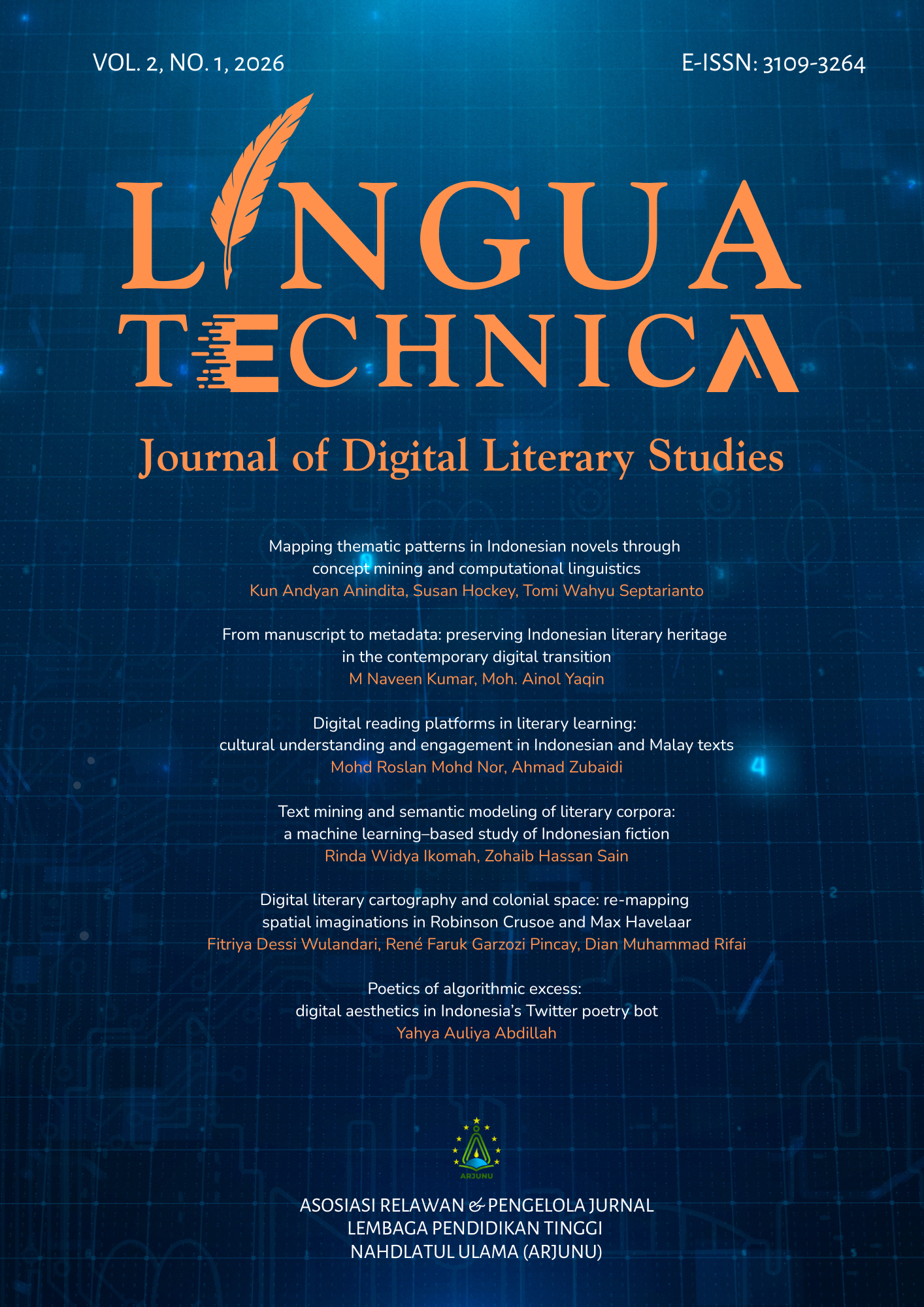
Digital literary cartography and colonial space: re-mapping spatial imaginations in Robinson Crusoe and Max Havelaar
DOI:
https://doi.org/10.64595/lingtech.v2i1.135Keywords:
colonial space, digital humanities, spatial imagination, cartography, postcolonial studiesAbstract
Background: The spatial turn in literary studies and digital humanities highlights the need to reassess how colonial space is constructed through the interaction between narrative and cartographic knowledge. Objective: This study examines how colonial spatial imagination is produced, contested, and differentiated in Robinson Crusoe (1719) and Max Havelaar (1860) through digital literary cartography. Method: Using a qualitative digital humanities design, the research integrates close textual analysis with historical cartographic materials and spatial metadata, focusing on Atlantic navigation maps, West Indies and New England coastal maps, and administrative maps of Java and Bantam. Results: The findings show that Robinson Crusoe aligns with a cartographic logic of enclosure and maritime circulation, reinforced by island, Atlantic, and West Indies maps that normalize spatial mastery. In contrast, Max Havelaar articulates a fragmented administrative geography, revealed through maps of Java and the Dutch East Indies that expose bureaucratic segmentation and ethical tension. Comparative re-mapping demonstrates divergent cartographic epistemologies shaped by exploration versus governance. Implication: Digital literary cartography reveals colonial space as an ideological construct rather than a neutral backdrop. Novelty: The study offers a comparative Global South–oriented cartographic reading that repositions maps as critical epistemic texts in colonial literature.
Downloads
References
Bandia, P. F. (2010). Literary heteroglossia and translation: Translating resistance in contemporary african francophone writing. In Translation, Resistance, Activism (pp. 168–189). https://www.jstor.org/stable/j.ctt5vk35x.12
Bandry-Scubbi, A. (2022). Zooming in, zooming out: 30 years of corpus stylistics bricolage. In Computational Stylistics in Poetry, Prose, and Drama (pp. 19–35). https://doi.org/10.1515/9783110781502-002
Ben Zid, M. A.-J., & Al Amri, H. S. (2022). From Page to Screen: Exploring Wordsworth’s “I Wandered Lonely as a Cloud” Through the Computational Lens of “Transpoemation.” Theory and Practice in Language Studies, 12(6), 1068–1075. https://doi.org/10.17507/tpls.1206.06
Benson, E., Brigg, M., Hu, K., Maddison, S., Makras, A., Moodie, N., & Strakosch, E. (2023). Mapping the spatial politics of Australian settler colonialism. Political Geography, 102. https://doi.org/10.1016/j.polgeo.2023.102855
Berendsen, M. E., Hamerlinck, J. D., & Webster, G. R. (2018). Digital story mapping to advance educational atlas design and enable student engagement. ISPRS International Journal of Geo-Information, 7(3), 125. https://doi.org/10.3390/ijgi7030125
Chitanya, G., Matta, R. A., Manoj Kumar, K. S., Sharma, A., & Prajapati, A. (2025). Spatial Imagination and the Literary Landscape: Exploring the Relationship Between Place, Identity, and Power in Postcolonial English Literature. Journal of Applied Bioanalysis, 11(4), 843–849. https://doi.org/10.53555/jab.v11i4.445
Cooper, D., Donaldson, C., & Murrieta-Flores, P. (2016). Literary mapping in the digital age (p. 315). https://doi.org/10.4324/9781315592596
Crowley, J. E. (2025). Is Landscape Imperial? In Landscape is…!: Essays on the Meaning of Landscape (pp. 114–142). https://doi.org/10.4324/9781003148142-7
Dekel, Y., & Marienberg-Milikowsky, I. (2021). From Distant to Public Reading The (Hebrew) Novel in the Eyes of Many. Magazen, 2(2), 225–252. https://doi.org/10.30687/mag/2724-3923/2021/01/003
Durić, D. (2015). From walking around the town to mapping: Daša Drndić’s Leica format as topographic prose. Fluminensia, 27(1), 171–188. https://hrcak.srce.hr/clanak/207626
Edelson, S. M., & Ferster, B. (2013). MapScholar: A web tool for publishing interactive cartographic collections. 9(1–2), 81–107. https://doi.org/10.1080/15420353.2012.747463
Efendi, A. N., Ahmadi, A., Indarti, T., & Kurniawati, E. (2026). Local Voices, Ecological Narratives, and Postcolonial Struggles: An Eco-Postcolonialism Reading of Indonesian Literature. International Journal of Critical Cultural Studies, 24(1), 137–154. https://doi.org/10.18848/2327-0055/CGP/v24i01/137-154
Fawaid, A., Fawaid, A., Faridy, Fachri, M., Assy’abani, R., & Huda, M. (2024). Aesthetic Disensus: Javanese Islamic Aesthetics and Political Subversion in Babad Tanah Jawi. Khazanah: Jurnal Studi Islam Dan Humaniora. https://doi.org/10.18592/khazanah.v22i1.13279
Fawaid, A., Udasmoro, W., & Margana, S. (2022). Politics of Prophecy in Java: A Mythological Narrative on Political Succession of Javanese Dynasties in Babad Tanah Jawi. Khazanah Sosial, 4(2), 312–326. https://doi.org/10.15575/ks.v4i2.17622
Given, L. M., & Willson, R. (2018). Information technology and the humanities scholar: Documenting digital research practices. Journal of the Association for Information Science and Technology, 69(6), 807–819. https://doi.org/10.1002/asi.24008
Jänicke, S., Franzini, G., Cheema, M. F., & Scheuermann, G. (2017). Visual Text Analysis in Digital Humanities. Computer Graphics Forum, 36(6), 226–250. https://doi.org/10.1111/cgf.12873
Johnson, B. L. (2019). Reading Course-Readings in Educational Leadership for All Their Worth: Tending to the Three Worlds of the Text. Journal of Research on Leadership Education, 14(2), 151–159. https://doi.org/10.1177/1942775117739675
Johnstone, R. L. (2022). Colonisation at the Poles: A Story of Ineffective Occupation. 13, 93–124. https://doi.org/10.1163/22116427_013010006
Jorge, R. (2023). Introduction. In New Directions in Irish and Irish American Literature: Part F1543 (pp. 1–39). https://doi.org/10.1007/978-3-031-40391-0_1
Koolen, M., Van Gorp, J., & Van Ossenbruggen, J. (2019). Toward a model for digital tool criticism: Reflection as integrative practice. Digital Scholarship in the Humanities, 34(2), 368–385. https://doi.org/10.1093/llc/fqy048
Kotikot, S. M., Smithwick, E. A. H., Gergel, S., Nankaya, J., Abila, R., & Mabwoga, S. (2025). Historical land policies influence contemporary landscape patterns in agropastoral landscapes. Landscape Ecology, 40(8). https://doi.org/10.1007/s10980-025-02178-x
Krishnan, M., & Cartwright, P. (2024). Postcolonial literary geographies. In The Routledge Handbook of Literary Geographies (pp. 61–70). https://doi.org/10.4324/9781003097761-7
Lay, J.-G., Chen, Y.-W., & Yap, K.-H. (2010). Geographic reality versus imagination in Taiwan’s historical maps. Cartographic Journal, 47(2), 180–189. https://doi.org/10.1179/000870410X12658023467402
Losada Palenzuela, J. L. (2019). Digital mapping of places in Spanish byzantine novels. Artnodes, 2019(23), 72–78. https://doi.org/10.7238/a.v0i23.3222
Mills, S. (2013). Gender and colonial space. Manchester University Press (p. 199). https://doi.org/10.7228/manchester/9780719053351.001.0001
Moslund, S. P. (2015). Karen Blixen’s Out of Africa (1937): Colonial Aesthetic and Decolonial Aisthesis. In Geocriticism and Spatial Literary Studies (pp. 135–151). https://doi.org/10.1057/9781137453228_9
Porter, L. (2007). Producing forests: A colonial genealogy of environmental planning in Victoria, Australia. Journal of Planning Education and Research, 26(4), 466–477. https://doi.org/10.1177/0739456X07301170
Radović, S. (2014). Locating the destitute: Space and identity in Caribbean fiction. University of Virginia Press. https://www.jstor.org/stable/j.ctt6wrm9c
Rieger, O. Y. (2010). Framing digital humanities: The role of new media in humanities scholarship. First Monday, 15(10). https://doi.org/10.5210/fm.v15i10.3198
Sampeck, K. E. (2014). From Ancient Altepetl to Modern Municipios: Surveying as Power in Colonial Guatemala. International Journal of Historical Archaeology, 18(1), 175–203. https://doi.org/10.1007/s10761-013-0251-0
Sarkowsky, K. (2010). Maps, borders, and cultural citizenship: Cartographic negotiations in Thomas King’s work. In Thomas King: Works and Impact. European Studies in North American Literature and Culture. Boydell & Brewer (pp. 210–223). ISBN: 9781571138309
Sen-Podstawska, S. S. (2024). WALKING WITH AND ON TURTLE ISLAND Indigenous Activist and Artistic Expressions in North America as Counter-Mapping Practices. Review of International American Studies, 17(2), 83–98. https://doi.org/10.31261/rias.16269
Thomas, L. (2013). Cartographic and literary intersections: Digital literary cartographies, digital humanities, and libraries and archives. Journal of Map and Geography Libraries, 9(3), 335–349. https://doi.org/10.1080/15420353.2013.823901
Thompson, L. (2017). Colonial governmentality in Puerto Rico and the Philippines: Sovereign force, governmental rationality, and disciplinary institutions under us rule. Political Power and Social Theory, 33, 21–46. https://doi.org/10.1108/S0198-871920170000033002
Tulbure, C. (2022). Mobility and post-socialism: cross-border shaming and un-belonging in a white Europe. State Crime Journal, 11(1), 110–127. https://doi.org/10.13169/STATECRIME.11.1.0110
Unigarro Caguasango, D. E. (2024). From Undulant Serpent to River Course: Amazon’s Colonial Representation and Cartographic Invention. Fronteras de La Historia, 29(2), 19–42. https://doi.org/10.22380/20274688.2633
van Es, K. (2023). Unpacking tool criticism as practice, in practice. Digital Humanities Quarterly, 17(2). https://digitalhumanities.org/dhq/vol/17/2/000692/000692.html
Whittingham, J., & McGarry, D. (2024). Mapping for connection, a life beyond mapping for control: Lessons from ‘mapping-as-performance’ with Empatheatre in South Africa. Frontiers in Marine Science, 11. https://doi.org/10.3389/fmars.2024.1320493
Wilmott, C. (2016). Small moments in Spatial Big Data: Calculability, authority and interoperability in everyday mobile mapping. Big Data and Society, 3(2). https://doi.org/10.1177/2053951716661364
Zamyatin, D. N. (2023). Co-spatiality and geo-cultural texts: from literary colonizations to cross-border cartographies of the imagination. Ural’skij Istoriceskij Vestnik, 81(4), 66–75. https://doi.org/10.30759/1728-9718-2023-4(81)-66-75
Downloads
Published
Issue
Section
License
Copyright (c) 2026 Fitriya Dessi Wulandari, René Faruk Garzozi Pincay, Dian Muhammad Rifai

This work is licensed under a Creative Commons Attribution-ShareAlike 4.0 International License.


























 (CC-BY-SA 4.0).