
Author Guidelines
The manuscript texts are written in English. Manuscripts will be first reviewed by editorial boards. The main text of a manuscript must be submitted as a Word document (.docx). The manuscript consists of 3000 - 6000 words (without references), well-typed in single column on A4 size paper, use font Nunito.The manuscript contains an original work and have potentially contribute to the highly scientific advancement. For more details, you can download [Article Template].
The manuscript should contain the following section in this order:
TITLE
Title should be short, bold, written with sentence case, informative, but does not exceed 15 words (16pt).
AUTHOR'S NAME
Full name without academic degrees and titles, written in capital letters. Manuscript written by groups needs to supplemented by complete contact details (10,5pt).
AFFILIATION FOR EACH AUTHOR
The author’s name should be accompanied by affiliation, country, and email address (10,5pt).
ABSTRACT
A single paragraph of about 150-250 words (9pt), written briefly in English. Background: provide a clear overview of the study by contextualizing the research question within a broader scope and explaining the study’s objectives. Method: provide a brief description of the methodologies employed in the research, ensuring clarity in the presentation of the approaches and any treatments used. Results: summarize the key findings of the study, capturing the essence of the data collected. Discussion: briefly summarize the interpretation of results that are thoroughly discussed and verified within the main text of the paper. Novelty: conclude this study with novelty derived from the research, emphasizing the state of art, contribution, and/or significance of the findings.
KEYWORDS
Written in English, 3-5 keywords; write your keywords alphabetically; recommended using keywords which contain in the title.
INTRODUCTION (mandatory) (upper case, 12pt)
The content of Introduction is left justified, 1 cm from the left of each paragraph headings, font size 10,5pt. This paragraph should start with a compelling statement about the social relevance of your research. Explain its necessity and urgency, and why this particular study needs to be written. This should provide a strong opening that sets the context for the research.
Outline what has previously been researched in relation to your topic. Highlight the existing body of knowledge and identify significant gaps that your study aims to fill. This helps to position your research within the broader academic conversation and justifies its originality and relevance. Recommended minimum 5 previous studies from international journal published at least previous 10 years (Mulatu & Regassa, 2022: Rajakannan & Rukmini, 2021)
Clearly state the objective of your study. This could be in the form of a question that your research aims to answer or a problem statement that you propose to solve. This paragraph should succinctly present the core of what your research seeks to achieve.
Propose a preliminary answer (assumption or hypothesis) to the research question or problem. This could be your hypothesis or the theoretical argument that your research will test. This paragraph may contain the statement of novelty of your research and its contribution on the spectrum of digital literary studies.
LITERATURE REVIEW (if applicable) (upper case, 12 pt)
The content of the Literature Review is left justified, 1 cm from the left of each paragraph headings, font size 10.5 pt. The literature review is organized around three main conceptual frameworks that form the analytical foundation of the study: Concept A, Concept B, and Concept C.
Each concept reviewed by outlining its various definitions as proposed by different scholars. The discussion highlights both convergent and divergent interpretations, emphasizing how Concept A is understood across disciplines or research traditions.
These definitional differences are important, as they influence how Concept A is operationalized and analyzed in empirical studies. Based on the reviewed literature, several key aspects or indicators of concept are identified, such as its core characteristics, scope of application, and contextual determinants.
Concept A
Concept text – concept text – concept text – concept text – concept text – concept text – concept text – concept text – concept text – concept text – concept text.
Concept B
Concept text – concept text – concept text – concept text – concept text – concept text – concept text – concept text – concept text – concept text – concept text.
Concept C
Concept text – concept text – concept text – concept text – concept text – concept text – concept text – concept text – concept text – concept text – concept text.
METHOD (mandatory) (upper case, 12pt)
The content of Method is left justified, 1 cm from the left of each paragraph headings, font size 10,5pt. Describe the material object of your study, such as location, place, case, institution, activity, program, artifact, or event. Specify whether your study is qualitative (e.g., case study, grounded research), quantitative (e.g., survey, experiment), or mixed-methods, providing reasons for your choice (Bernstein & Hopper, 2017).
List the sources from which you will collect your data, including respondents, informants, or texts (e.g., manuscripts, books, online articles). Outline how you will gather data, such as through desk-review, observation, interviews (structured, semi-structured), or focus group discussions. Describe the stages of data analysis (e.g., data reduction, data display, verification) and the methods you will use (e.g., content analysis, discourse analysis, interpretative analysis).
If necessary, method may contains some subsections, including:
Research design
Methodology text -methodology text -methodology text -methodology text -methodology text -methodology text -methodology text -methodology text -methodology text.
Data collection
Methodology text -methodology text -methodology text -methodology text -methodology text -methodology text -methodology text -methodology text -methodology text.
Data analysis
Methodology text -methodology text -methodology text -methodology text -methodology text -methodology text -methodology text -methodology text -methodology text.
RESULTS (mandatory) (upper case, 12pt)
The content of Results is left justified, 1 cm from the left of each paragraph headings, font size 10,5pt. In this section, present the initial data using various visualization tools like tables, graphs, or images to enhance understanding.
Describe the patterns or trends observed in the visualized data. This should offer a clear depiction of the findings, detailing the significant aspects that are evident from the data.
Analyze and explain the implications of the data presented. Discuss how these results align with or challenge existing theories or literature, providing a deeper insight into their significance (Parsons, et.al, 2023).
Tables
All inserted tables should have a specific caption above the tables, center position, font size 10,5pt. Only horizontal lines should be used within a table, to distinguish the column headings from the body of the table, and immediately above and below the table. Tables must be embedded into the text and not supplied separately. Please make sure that all text in the tables is readable - font size 10,5pt – 9pt. If necessary, provide a source of the figure with hyperlink to the original source (Bygstad & Munkvold, 2016).
Table 2. The integration of gamification in the literary learning

*) groups = control and experiment
Figures
Place figure captions below the figures, center position, font size 10,5pt. If your figure has two parts, include the labels “(a)” and “(b)” etc., or provide each captions of these figures. Please verify that the figures you mention in the text actually exist. Do not put borders around the outside of your figures. Use the phrase “Figure. ...” even at the beginning of a sentence. In the case of photos etc. a resolution of 300 dpi should be provided. Please make sure that all text in the Figures is readable. If necessary, provide a source of the figure with hyperlink to the original source (Mulatu & Regassa, 2022).
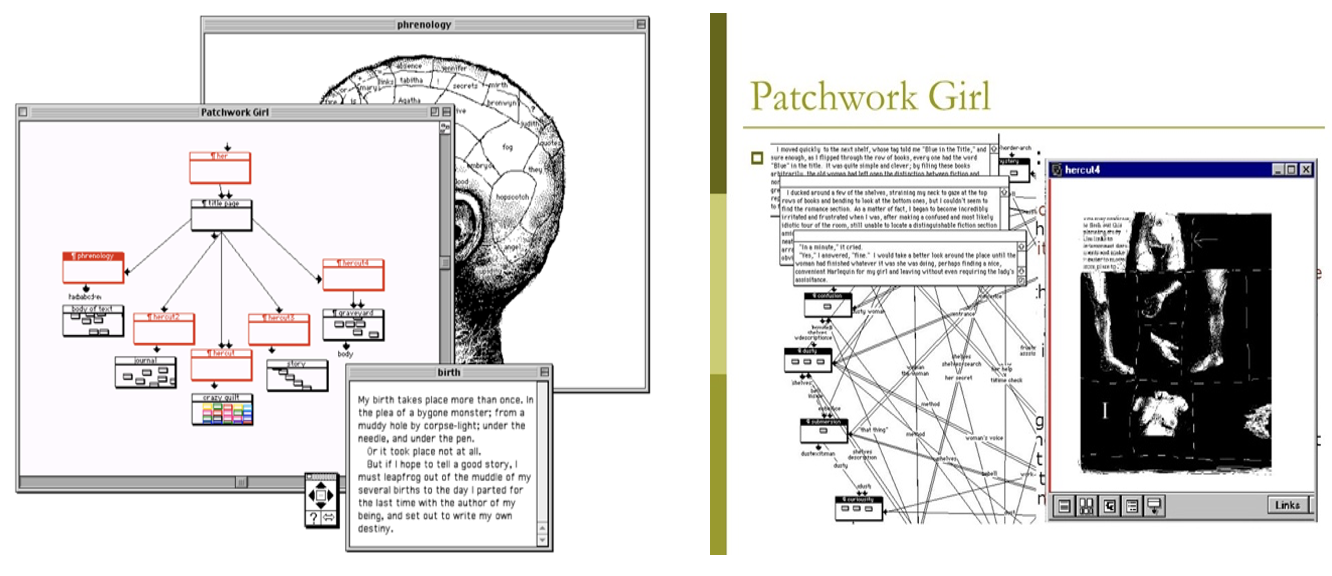
Figure 1. Displays of Patchwork Girl hypertext fiction
(Source: A video of Shelley Jackson reading Patchwork Girl CD-ROM)
Equations
It is possible to use either the Microsoft Equation Editor or the MathType add-on (http://www.mathtype.com) for equations in your paper. Formulae should be numbered consecutively throughout the manuscript as Equation 1 and Equation 2. Formulae should be numbered (Rajakannan & Rukmini, 2021).
 (1)
(1)
Text continue here.
 (2)
(2)
Text continues here.
Rendemen % = Dry Pectin Weight gDry Raw Material Weight g×100 (3)
Abbreviations and acronyms
Define abbreviations and acronyms the first time they are used in the text, even after they have already been defined in the abstract. Abbreviations such as SI (International System of Units) do not have to be defined. Do not use abbreviations in the title unless they are unavoidable (Bell & Ensslin, 2024).
DISCUSSION (upper case, 12pt)
The content of Discussion is left justified, 1 cm from the left of each paragraph headings, font size 10,5pt. This session should explore the broader implications of the results, discussing what the potential impact on theory, practice, or further research.
Delve into the underlying structure or mechanisms behind the observed results. This analysis should help clarify why these results occurred and their relevance to the established research questions (Bernstein & Hopper, 2017).
CONCLUSION (mandatory) (upper case, 12pt)
The content of Conclusion is left justified, around 200-300 words, 1 cm from the left of each paragraph headings, font size 10,5pt. Conclusion is not a summary. Do not repeat the abstract.
Please summarize the most critical discoveries of the research or the lessons learned. Discuss the strengths of the research, including its methodological rigor, innovation, and any contributions it makes to the field. Highlight how this study has advanced understanding or opened new avenues for investigation.
Conclude by acknowledging the limitations of the study. This transparency allows for an honest appraisal of the research's scope and depth. Additionally, provide the recommended areas for future research that could build on your findings, addressing these limitations or taking the inquiry further.
ACKNOWLEDGMENTS (if applicable) (upper case, 12pt)
This section should acknowledge individuals who provided personal assistance to the work but do not meet the criteria for authorship, detailing their contributions. It is imperative to obtain consent from all individuals listed in the acknowledgments.
FUNDING INFORMATION (if applicable) (upper case, 12pt)
This section should describe sources of funding agency that have supported the work. Authors should state how the research described in their article was funded, including grant numbers if applicable. Include the following (or similar) statement if there is no funding involved: Authors state no funding involved.
AUTHOR CONTRIBUTIONS STATEMENT (mandatory) (upper case, 12pt)
This journal mandating CRediT (Contributor Roles Taxonomy) will enable authors to provide information on submission, allowing for detailed information about individual contributions to the work. The submitting author is responsible for ensuring that contributions of all authors are correct. It is expected that all authors will have reviewed, discussed, and agreed to their individual contributions as shared by the submitting author. The authors’ contribution statement will be published with the final article and should accurately reflect contributions to the work. To see the complete Credit classification, see: https://authorservices.wiley.com/author-resources/Journal-Authors/open-access/credit.html
An example of an Authors’ Contribution statement using CRediT with degree of contribution: Pierro Asara: review and editing (equal). Kerys Jones: Conceptualization (lead); writing – original draft (lead); formal analysis (lead); writing – review and editing (equal). Elisha Roberto: Software (lead); writing – review and editing (equal). Hebei Wang: Methodology (lead); writing – review and editing (equal). Jinnie Wu: Conceptualization (supporting); Writing – original draft (supporting); Writing – review and editing (equal).
CONFLICT OF INTEREST STATEMENT (mandatory) (upper case, 12pt)
To ensure fair and objective decision-making, authors must declare any associations that pose a conflict of interest (financial, personal, or professional) in connection with manuscripts. Non-financial competing interests include a declaration of political, personal, religious, ideological, academic, and intellectual competing interests. The authors declare that they have no known competing financial interests or personal relationships that could have appeared to influence the work reported in this paper. If there are no conflicts of interest, please include the following author's statement: Authors state no conflict of interest.
INFORMED CONSENT (if applicable) (upper case, 12pt)
The protection of privacy is a legal right that must not be breached without individual informed consent. In cases where the identification of personal information is necessary for scientific reasons, authors should obtain full documentation of informed consent, including written permission from the patient prior to inclusion in the study. Incorporate the following (or a similar) statement: We have obtained informed consent from all individuals included in this study.
ETHICAL APPROVAL (if applicable) (upper case, 12pt)
When papers talk about using people or animals, authors should make it clear that the research followed all national rules and institutional policies, and it was approved by the authors' institutional review board or a similar committee. The Helsinki Declaration's tenets must guide all investigations involving human subjects. Authors must also identify the committee or review board approving the experiments and provide a statement indicating approval of the research. Incorporate the following (or a similar) statement: This research related to human use has been complied with all the relevant national regulations and institutional policies in accordance with the tenets of the Helsinki Declaration and has been approved by the authors' institutional review board or equivalent committee; or: This research related to animal use has been complied with all the relevant national regulations and institutional policies for the care and use of animals.
DATA AVAILABILITY (mandatory) (upper case, 12pt)
Please include one of the following statements in your manuscript. Choose the option that best fits your study.
- If the data are publicly available, please write: The data supporting the findings of this study are publicly available at [repository name]: [DOI or URL].
- If the data will be available after an embargo, please write: The data supporting the findings of this study will be available at [repository name] ([DOI/URL]) after a [time period, e.g., 6 months] embargo from the date of publication.
- If the data are available on reasonable request, please write: The data supporting the findings of this study are available from the corresponding author upon reasonable request.
- If the data cannot be publicly shared (ethical/privacy reasons), please write: The data supporting the findings of this study are not publicly available due to ethical and privacy restrictions, but are available from the corresponding author upon reasonable request.
- If the data come from a third party, please write: The data supporting the findings of this study were obtained from [third party name] and are available with the permission of that third party.
- If all data are included in the article, please write: All data supporting the findings of this study are included in this article and/or its supplementary materials.
- If no new data were created or analyzed, please write: Data availability is not applicable to this article as no new data were created or analyzed in this study.
REFERENCES (mandatory) (upper case, 12pt)
The content of References is left justified, font size 10,5pt. References heading should be left justified, bold, with the first letter capitalized without number. American Psychological Association (APA) 7th Edition reference style is required in this journal. References should be written using standard citation applications with DOI and/or link of the sources. In writing Citations and References, Lingua Technica uses the Zotero Reference Management Software. At least 70% of references should be cited from up-to-date journals (international reputation journals) published in the last 5 years, but the rest of 30% of references can be cited from research reports, and or articles. The minimum number of reference lists is 25 references.
Example:
Journal article
Mulatu, E., & Regassa, T. (2022). Teaching reading skills in EFL classes: Practice and procedures teachers use to help learners with low reading skills. Cogent Education, 9(1). https://doi.org/10.1080/2331186X.2022.2093493
Rajakannan, R., & Rukmini, S. (2021). Reading paradigms of digital narratives: reception of hypertext fictions and its implications. NALANS: Journal of Narrative and Language Studies, 9(18), 357–380. https://nalans.com/index.php/nalans/article/view/450
Conference proceeding
Parsons, T. D., Asbee, J., & Courtney, C. G. (2023). Interaction of cognitive and affective load within a virtual city. IEEE Transactions on Affective Computing, 14(4), 2768–2775. https://doi.org/10.1109/TAFFC.2022.3220953
Book section or book
Bygstad, B., & Munkvold, B. E. (2016). Exploring the role of informants in interpretive case study research in IS. In Enacting Research Methods in Information Systems: Volume 2 (pp. 84–115). https://doi.org/10.1007/978-3-319-29269-4_4
Bell, A., & Ensslin, A. (2024). Reading digital fiction: narrative, cognition, mediality (p. 207). https://doi.org/10.4324/9781003110194
Internet/Webpage Article
Bernstein, M., & Hopper, M. (2017). Hypertext in historical context: Vannevar Bush and Ted Nelson Revisited. Common Forum MIT. https://commforum.mit.edu/hypertext-in-historical-context-vannevar-bush-and-ted-nelson-revisited-bc527272125
For more details, you can download [Article Template].
























 (CC-BY-SA 4.0). This license permits sharing and adaptation, including for commercial purposes, provided that appropriate credit is given, a link to the license is supplied, changes are indicated, and derivative works are distributed under the same license.