
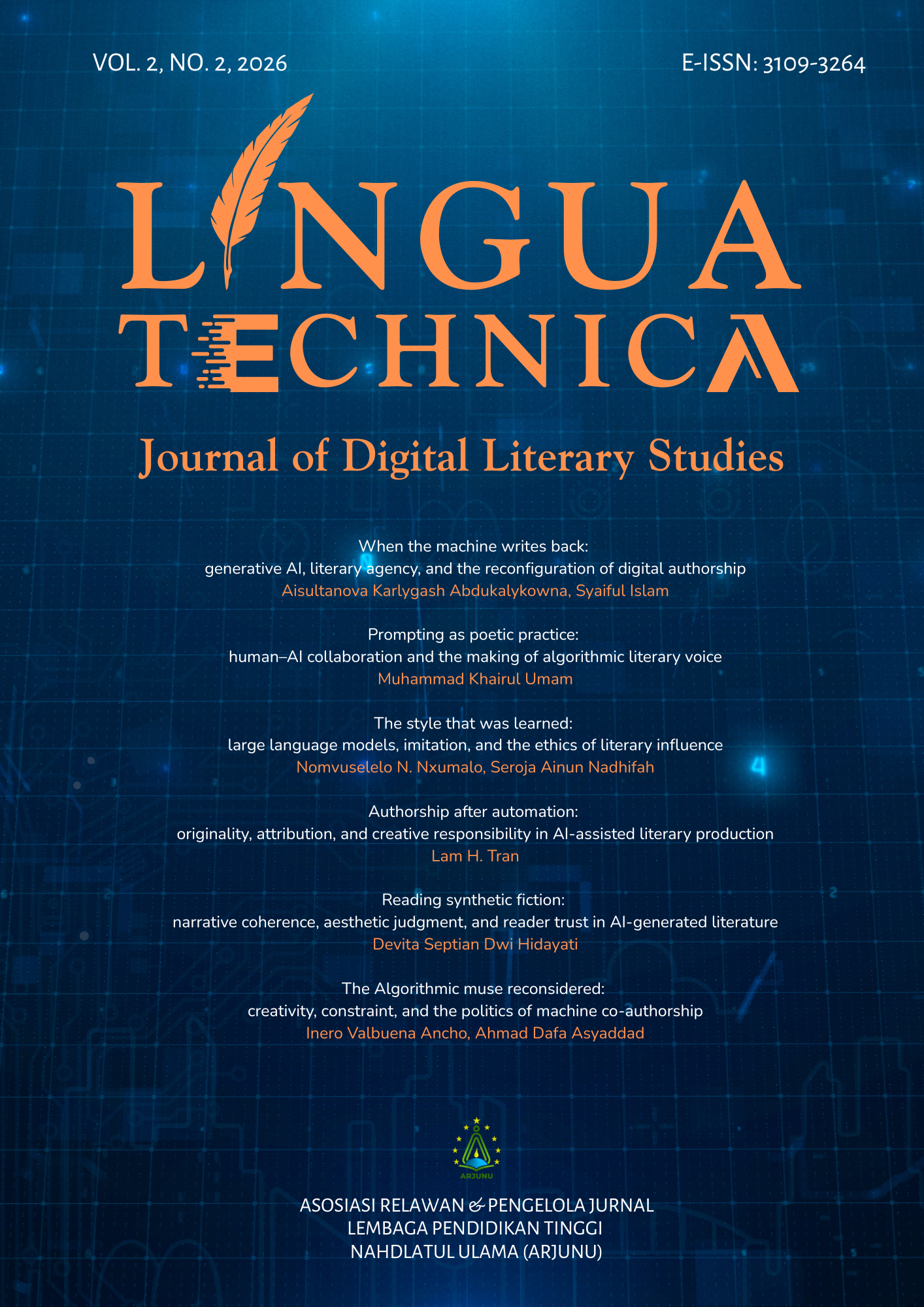
When the machine writes back: generative AI, literary agency, and the reconfiguration of digital authorship
DOI:
https://doi.org/10.64595/lingtech.v2i2.152Keywords:
AI-assisted writing, digital authorship, disclosure governance, generative AI, literary agencyAbstract
Background: Generative artificial intelligence has destabilized conventional literary authorship by separating textual production from ownership, responsibility, and institutional recognition across digital publishing environments. Objective: This study examines how human writers, generative systems, editors, publishers, platforms, and cultural institutions redistribute literary agency, attribution, disclosure, and legitimacy. Method: Using a qualitative comparative corpus design, this study analyzed 42 public documents published between 2021 and 11 July 2026, comprising 15 primary, 13 secondary, and 14 contextual sources through distributed-authorship mapping, workflow-chain analysis, and paratextual governance analysis. Results: Human actors retained legal, editorial, and ethical primacy, although machines increasingly occupied visible roles in drafting, stylistic production, and symbolic co-authorship. Literary agency operated across prompting, generation, selection, revision, arrangement, performance, and publication rather than residing exclusively in sentence production. Disclosure functioned constitutively, legitimizing experimentation in some contexts while enabling suspicion, restriction, or prohibition in others. Implication: Digital authorship should therefore be evaluated as a governed attribution network in which distributed creativity remains asymmetrical because accountability continues to rest with identifiable human and institutional actors. Novelty: This study integrates literary texts, creator accounts, publisher paratexts, media reception, platform rules, and policy documents within one auditable framework connecting attribution, workflow, and governance across contemporary transnational literary ecosystems.
Downloads
References
Abdillah, Y. A. (2026). Poetics of algorithmic excess: Digital aesthetics in Indonesia’s Twitter poetry bot. Lingua Technica: Journal of Digital Literary Studies, 2(1), 86–101. https://doi.org/10.64595/lingtech.v2i1.138
Amirjalili, F., Neysani, M., & Nikbakht, A. (2024). Exploring the boundaries of authorship: A comparative analysis of AI-generated text and human academic writing in English literature. Frontiers in Education. https://doi.org/10.3389/feduc.2024.1347421
Authors Guild. (2023, May 15). Survey reveals 90 percent of writers believe authors should be compensated for AI training use. https://authorsguild.org/news/ai-survey-90-percent-of-writers-believe-authors-should-be-compensated-for-ai-training-use/
Belcher, D. (2024). The promising and problematic potential of generative AI as a leveler of the publishing playing field. Journal of English for Research Publication Purposes. https://doi.org/10.1075/jerpp.00025.bel
Bozkurt, A. (2024). GenAI et al.: Cocreation, authorship, ownership, academic ethics and integrity in a time of generative AI. Open Praxis, 16(1). https://doi.org/10.55982/openpraxis.16.1.654
Crawford, J., Purvis, A., Grieve, A., & Taylor, L. (2026). Authorship statement for generative artificial intelligence: Assuring trust and accountability. Journal of University Teaching and Learning Practice. https://doi.org/10.53761/v16abt43
Day, K., Michael, R., Otmar, R., & Mullins, S. (2024). Editorial intelligence versus artificial intelligence for literary fiction manuscript development. New Writing, 22, 3–19. https://doi.org/10.1080/14790726.2024.2425020
Doshi, A. R., & Hauser, O. P. (2024). Generative AI enhances individual creativity but reduces the collective diversity of novel content. Science Advances, 10, eadn5290. https://doi.org/10.1126/sciadv.adn5290
Draxler, F., Werner, A., Lehmann, F., Hoppe, M., Schmidt, A., Buschek, D., & Welsch, R. (2023). The AI ghostwriter effect: When users do not perceive ownership of AI-generated text but self-declare as authors. ACM Transactions on Computer-Human Interaction, 31, 1–40. https://doi.org/10.1145/3637875
Fawaid, A. (2025). Mapping the field of digital literary studies: Concepts, methods, and emerging directions. Lingua Technica: Journal of Digital Literary Studies, 1(1), 1–13. https://doi.org/10.64595/99c6t274
Formosa, P., Bankins, S., Matulionyte, R., & Ghasemi, O. (2024). Can ChatGPT be an author? Generative AI creative writing assistance and perceptions of authorship, creatorship, responsibility, and disclosure. AI & Society, 40, 3405–3417. https://doi.org/10.1007/s00146-024-02081-0
Gürsoy, A., & Şavk, S. (2024). From scriptor to promptor: An evaluation of the status of authorship, authenticity, and creativity in light of the use of artificial intelligence in screenwriting. ARTS: Artuklu Sanat ve Beşeri Bilimler Dergisi. https://doi.org/10.46372/arts.1482636
Hadan, H., Wang, D. M., Mogavi, R. H., Tu, J., Zhang-Kennedy, L., & Nacke, L. (2024). The great AI witch hunt: Reviewers’ perception and (mis)conception of generative AI in research writing. Computers in Human Behavior: Artificial Humans, 2, 100095. https://doi.org/10.1016/j.chbah.2024.100095
Herdiana, N. (2025). From hypertext to interactive narrative: Structure, agency, and multimodal meaning-making of e-literature. Lingua Technica: Journal of Digital Literary Studies, 1(1), 14–27. https://doi.org/10.64595/gazjdj89
Hutson, J. (2024). Rethinking plagiarism in the era of generative AI. Journal of Intelligent Communication, 4(1). https://doi.org/10.54963/jic.v4i1.220
Hwang, Y., & Lee, J. H. (2025). Exploring students’ experiences and perceptions of human–AI collaboration in digital content making. International Journal of Educational Technology in Higher Education, 22. https://doi.org/10.1186/s41239-025-00542-0
Jiang, J., Vetter, M. A., & Lucia, B. (2024). Toward a “more-than-digital” AI literacy: Reimagining agency and authorship in the postdigital era with ChatGPT. Postdigital Science and Education, 6, 922–939. https://doi.org/10.1007/s42438-024-00477-1
Kaebnick, G., Magnus, D., Kao, A., Hosseini, M., Resnik, D. B., Dubljević, V., Rentmeester, C., & Gordijn, B. (2023). Editors’ statement on the responsible use of generative artificial intelligence technologies in scholarly journal publishing. Bioethics. https://doi.org/10.1111/bioe.13220
Nadifah, S. A. (2025). Language, code, and platform-mediated textuality in electronic literature. Lingua Technica: Journal of Digital Literary Studies, 1(1), 28–40. https://doi.org/10.64595/80xngp06
Nakano, H., Takezawa, J., Matulic, F., Yang, C.-L., & Yatani, K. (2025). Understanding reader perception shifts upon disclosure of AI authorship. Proceedings of the 31st International Conference on Intelligent User Interfaces. https://doi.org/10.48550/arXiv.2510.24011
Nunes, R. (2024). AI, a tool or an author? A posthuman feminist perspective on the agency of Gen-AI in creative practices. Augmented Human Research, 9. https://doi.org/10.1007/s41133-024-00074-8
Perkins, M., & Roe, J. (2023). Academic publisher guidelines on AI usage: A ChatGPT-supported thematic analysis. F1000Research, 12. https://doi.org/10.12688/f1000research.142411.2
Raitskaya, L., & Tikhonova, E. (2025). The 2025 landscape of generative AI in scholarly writing and publishing: A scoping review of uses and ethical approaches. Journal of Language and Education. https://doi.org/10.17323/jle.2025.29876
Senftleben, M. (2023). Generative AI and author remuneration. IIC—International Review of Intellectual Property and Competition Law, 54, 1535–1560. https://doi.org/10.1007/s40319-023-01399-4
Shah, N. (2026). What is a digital author? Generative AI, concealment, and notes for the emergent moment. Communication and the Public. https://doi.org/10.1177/20570473261416537
Suaidi. (2025). Reader participation, platform affordances, and interactive meaning-making in online literary environments. Lingua Technica: Journal of Digital Literary Studies, 1(1), 54–66. https://doi.org/10.64595/9gy6p728
Tsao, J., & Nogues, C. (2024). Beyond the author: Artificial intelligence, creative writing and intellectual emancipation. Poetics, 101865. https://doi.org/10.1016/j.poetic.2024.101865
U.S. Copyright Office. (2025). Copyright and artificial intelligence, Part 2: Copyrightability. https://www.copyright.gov/ai/Copyright-and-Artificial-Intelligence-Part-2-Copyrightability-Report.pdf
Wang, C., Xu, W., & Tan, X. (2025). Advanced multilingual writers’ self-directed use of generative AI in academic writing: Rethinking writing, authorship, and learning. Applied Linguistics. https://doi.org/10.1093/applin/amaf057
Downloads
Published
Issue
Section
License
Copyright (c) 2026 Aisultanova Karlygash Abdukalykowna, Syaiful Islam

This work is licensed under a Creative Commons Attribution-ShareAlike 4.0 International License.






















 (CC-BY-SA 4.0).