
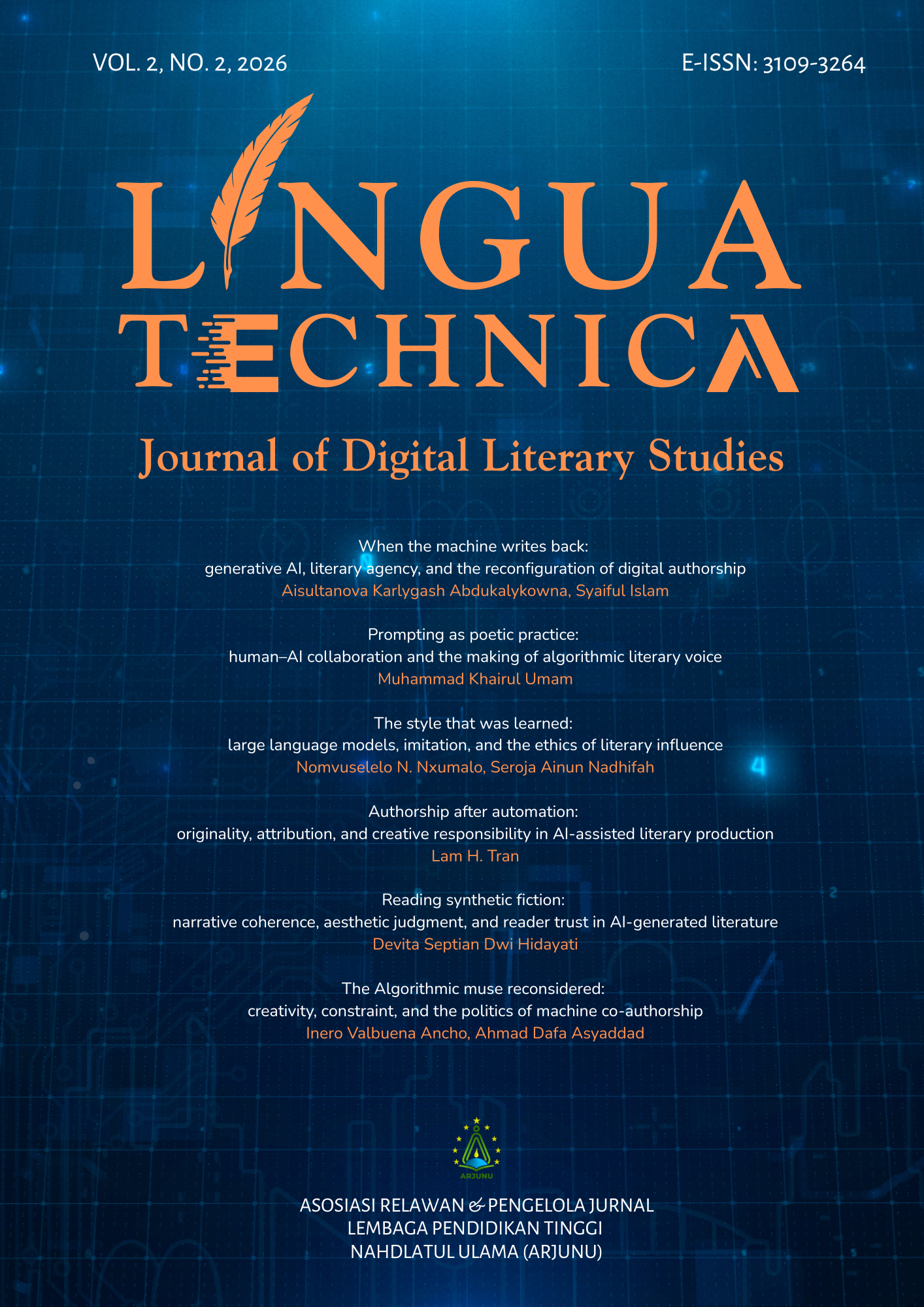
Reading synthetic fiction: narrative coherence, aesthetic judgment, and reader trust in AI-generated literature
DOI:
https://doi.org/10.64595/lingtech.v2i2.156Keywords:
Aesthetic judgment, AI-generated literature, narrative coherence, reader trust, synthetic fictionAbstract
Background: AI-generated fiction has become increasingly readable, yet its literary acceptance depends on more than fluency, because readers must also perceive coherent organization, aesthetic purpose, and trustworthy narrative agency across platforms, classrooms, publishing experiments, and increasingly ordinary digital reading environments worldwide today. Objective: This study investigates how narrative coherence, aesthetic judgment, and reader trust interact in the reception of synthetic fiction. Method: This study applies a qualitative-dominant comparative design to twelve English-language AI-generated short stories, combining a six-dimensional coherence matrix, a six-dimensional aesthetic rubric, and a six-dimensional trust framework with preserved reader-ranking metadata. Results: Most narratives sustained event sequence, temporal continuity, entity stability, and closure, although causal linkage remained comparatively uneven. Aesthetic evaluation was weaker than coherence, particularly in emotional resonance, interpretive depth, and imagery, while originality and stylistic control varied across models. Reader trust was strongest at the level of narrative reliability but declined when authenticity, intentionality, literary legitimacy, continuation, and recommendation were considered. Implication: These findings indicate that readable synthetic fiction may remain only conditionally literary when formal coherence is not accompanied by aesthetic distinction and perceived purpose. Novelty: This study advances an integrated reader-centered framework that separates intelligibility, literary valuation, and trust while preserving their analytical interdependence.
Downloads
References
Abdillah, Y. A. (2026). Poetics of algorithmic excess: Digital aesthetics in Indonesia’s Twitter poetry bot. Lingua Technica: Journal of Digital Literary Studies, 2(1), 86–101. https://doi.org/10.64595/lingtech.v2i1.138
Alabdulkarim, A., Li, S., & Peng, X. (2021). Automatic story generation: Challenges and attempts. arXiv. https://doi.org/10.18653/v1/2021.nuse-1.8
Ali, E., Ahmed, F., Usmani, S., & Kottaparamban, M. (2026). Readers’ engagement with and perception of AI-generated narratives in the context of digital literature. Journal of Language Teaching and Research. https://doi.org/10.17507/jltr.1701.33
Alasmari, J., Alzyoudi, M., Alshehri, M., Alshammari, R., & Aldakan, R. (2025). An automated predictive model for evaluating narrative cohesion in children’s stories: A computational linguistic approach considering Gérard Genette’s narrative structure theory. International Journal of Adolescence and Youth, 30. https://doi.org/10.1080/02673843.2025.2500527
Bajohr, H. (2024a). On artificial and post-artificial texts: Machine learning and the reader’s expectations of literary and non-literary writing. Poetics Today. https://doi.org/10.1215/03335372-11092990
Bajohr, H. (2024b). The deixis of literature: On the conditions for recognizing computers as authors. Orbis Litterarum. https://doi.org/10.1111/oli.12450
Beguš, N. (2024). Experimental narratives: A comparison of human crowdsourced storytelling and AI storytelling. Humanities and Social Sciences Communications, 11. https://doi.org/10.1057/s41599-024-03868-8
Callan, D., & Foster, J. (2023). How interesting and coherent are the stories generated by a large-scale neural language model? Comparing human and automatic evaluations of machine-generated text. Expert Systems, 40, e13292. https://doi.org/10.1111/exsy.13292
Doshi, A. R., & Hauser, O. P. (2024). Generative AI enhances individual creativity but reduces the collective diversity of novel content. Science Advances, 10, eadn5290. https://doi.org/10.1126/sciadv.adn5290
Fawaid, A. (2025). Mapping the field of digital literary studies: Concepts, methods, and emerging directions. Lingua Technica: Journal of Digital Literary Studies, 1(1), 1–13. https://doi.org/10.64595/99c6t274
Goyal, T., Li, J. J., & Durrett, G. (2022). SNaC: Coherence error detection for narrative summarization. arXiv. https://doi.org/10.48550/arXiv.2205.09641
Li, J., Chen, Y., Liu, Z., Tan, M., Zhang, L., Li, Y., Luo, R., Chen, L., Luo, J., Argha, A., Alinejad-Rokny, H., Zhou, W., & Yang, M. (2025). STORYTELLER: An enhanced plot-planning framework for coherent and cohesive story generation. arXiv. https://doi.org/10.48550/arXiv.2506.02347
Manzanarez, G. A., De La Cruz Arana, N., Flores, J., Medina, Y. G., Monroy, R., & Pernelle, N. (2025). Can artificial intelligence write like Borges? An evaluation protocol for Spanish microfiction. Applied Sciences, 15(12), 6802. https://doi.org/10.3390/app15126802
Marco, G., Gonzalo, J., & Fresno-Fernández, V. (2025). The reader is the metric: How textual features and reader profiles explain conflicting evaluations of AI creative writing. In Findings of the Association for Computational Linguistics: ACL 2025. https://doi.org/10.48550/arXiv.2506.03310
Mikros, G. (2025). Beyond the surface: Stylometric analysis of GPT-4o’s capacity for literary style imitation. Digital Scholarship in the Humanities, 40, 587–600. https://doi.org/10.1093/llc/fqaf035
Nor, M. R. M., & Zubaidi, A. (2026). Digital reading platforms in literary learning: Cultural understanding and engagement in Indonesian and Malay texts. Lingua Technica: Journal of Digital Literary Studies, 2(1), 33–50. https://doi.org/10.64595/lingtech.v2i1.131
Papalampidi, P., Cao, K., & Kočiský, T. (2022). Towards coherent and consistent use of entities in narrative generation. In Proceedings of the 2022 Conference on Empirical Methods in Natural Language Processing (pp. 17278–17294).
Piper, A., So, R., & Bamman, D. (2021). Narrative theory for computational narrative understanding. In Proceedings of the 2021 Conference on Empirical Methods in Natural Language Processing (pp. 298–311). https://doi.org/10.18653/v1/2021.emnlp-main.26
Porter, B., & Machery, E. (2024). AI-generated poetry is indistinguishable from human-written poetry and is rated more favorably. Scientific Reports, 14. https://doi.org/10.1038/s41598-024-76900-1
Rettberg, J. W., & Wigers, H. (2025). AI-generated stories favour stability over change: Homogeneity and cultural stereotyping in narratives generated by GPT-4o-mini. Open Research Europe. https://doi.org/10.12688/openreseurope.20576.1
Rodrigues, T. V. (2026). The epistemology of algorithmic narrative and the problem of creative authenticity. Philosophy & Technology, 39. https://doi.org/10.1007/s13347-025-01011-2
Stańko-Kaczmarek, M., Dera, L., & Kościelska, H. (2024). “Between the lines”: Perceptions of poetry with authorship attributed to artificial intelligence or humans—A comparative analysis. The Journal of Creative Behavior. https://doi.org/10.1002/jocb.1513
Suaidi. (2025). Reader participation, platform affordances, and interactive meaning-making in online literary environments. Lingua Technica: Journal of Digital Literary Studies, 1(1), 54–66. https://doi.org/10.64595/9gy6p728
Wang, S., & Huang, G. (2024). The impact of machine authorship on news audience perceptions: A meta-analysis of experimental studies. Communication Research, 51, 815–842. https://doi.org/10.1177/00936502241229794
Yang, D., & Jin, Q. (2024). What makes a good story and how can we measure it? A comprehensive survey of story evaluation. arXiv. https://doi.org/10.48550/arXiv.2408.14622
Downloads
Published
Issue
Section
License
Copyright (c) 2026 Devita Septian Dwi Hidayati

This work is licensed under a Creative Commons Attribution-ShareAlike 4.0 International License.





















 (CC-BY-SA 4.0).