
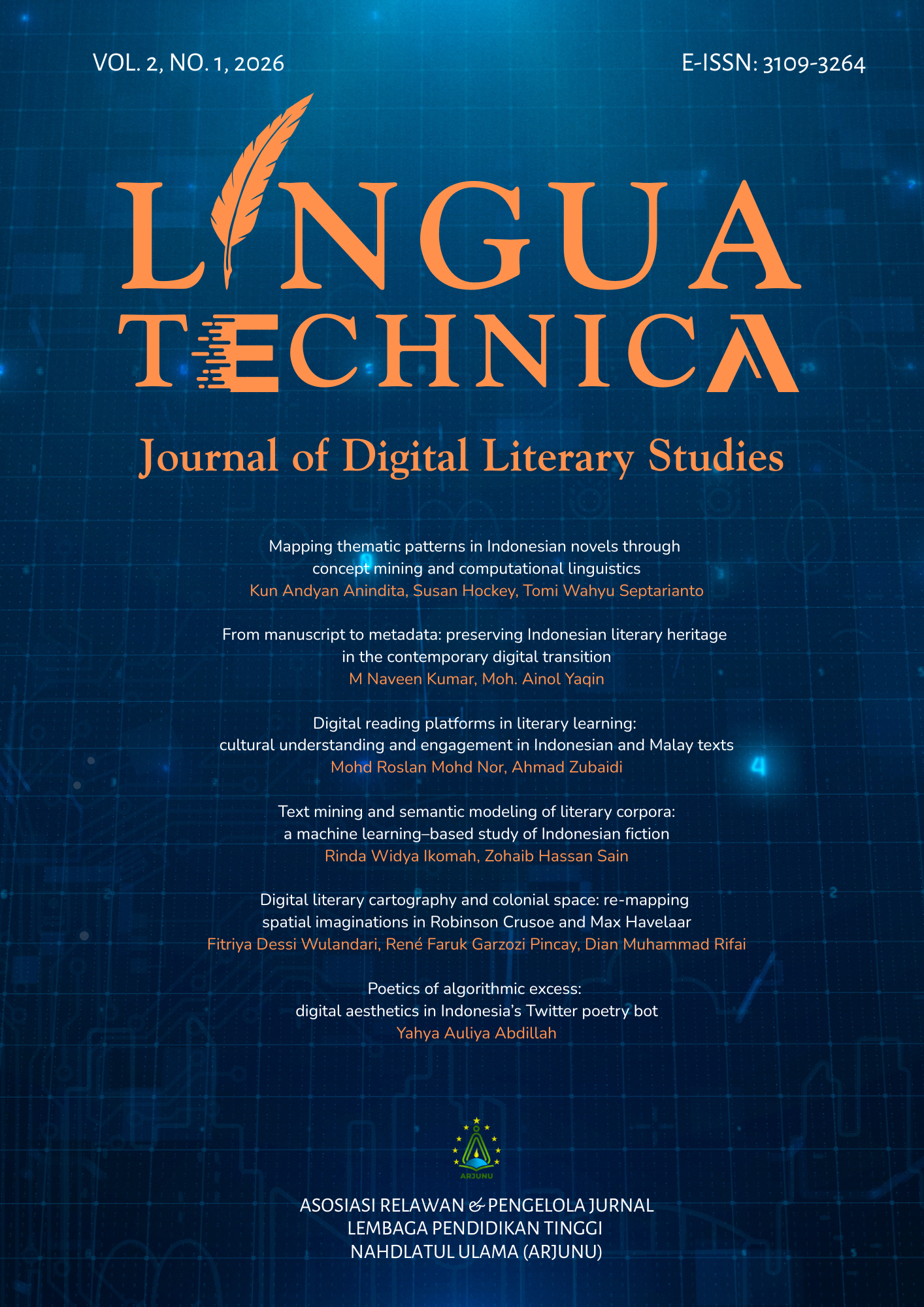
Poetics of algorithmic excess: digital aesthetics in Indonesia’s Twitter poetry bot
DOI:
https://doi.org/10.64595/lingtech.v2i1.138Keywords:
algorithmic poetry, digital literature, distributed authorship, platform poetics, Twitter botsAbstract
Background: The rapid expansion of social media platforms has transformed literary production, enabling algorithmic poetry to emerge as a digital-native form that challenges conventional notions of authorship, meaning, and aesthetic value. Objective: This study examines how Indonesian Twitter bot poetry operates as a poetics of algorithmic excess, with attention to formal patterns, semantic instability, and platform-mediated authorship. Method: Using a qualitative digital humanities approach, the research analyzes a corpus of 240 poems generated by an Indonesian Twitter poetry bot through close reading, pattern identification, and platform-aware interpretation. Results: The findings show that algorithmic repetition and structural fragmentation function as dominant formal strategies, displacing expressive intentionality with procedural regularity. Semantic noise and randomness produce episodic meaning, shifting interpretive responsibility from author to reader. Platform circulation redistributes authorship among algorithms, users, and infrastructural systems, positioning Twitter/X as a co-author in literary production. Implications: Algorithmic poetry constitutes a legitimate literary practice shaped by platform capitalism and posthuman creativity. Novelty: The study offers a Global South perspective on digital poetics by theorizing algorithmic excess as an aesthetic principle within platform-mediated literature.
Downloads
References
Abdullah, I., Afriadi, D., Yusuf, M., Susanto, M., & Fawaid, A. (2025). The Optics of Leadership: Visual Representation in the 2024 Indonesian Presidential Campaign. VISUAL REVIEW. International Visual Culture Review/Revista Internacional de Cultura Visual, 17(2), 133–145. https://doi.org/10.62161/revvisual.v17.5273
Ajith, A., & Ravichandran, T. (2025). Pixels, print and poetic intersections: Visualizing AI in PoemPortraits and Technelegy. Journal of Visual Literacy, 44(4), 406–429. https://doi.org/10.1080/1051144X.2025.2569016
Andzulis, J. M., Ogilvie, J. L., Johnson, C. M., & Davis, L. M. (2016). A Qualitative Exploration of Student Perspectives on Social Media use, Abuse and Content. In Developments in Marketing Science: Proceedings of the Academy of Marketing Science (p. 425). https://doi.org/10.1007/978-3-319-24184-5_111
Bulut, E. (2025). Globally connected, nationally restrained: Platform ambiguities and censorship in Turkey’s drama production. International Journal of Cultural Studies, 28(1), 99–115. https://doi.org/10.1177/13678779241254541
Camacho, D., Lara-Cabrera, R., Merelo-Guervós, J. J., Castillo, P. A., Cotta, C., Fernández-Leiva, A. J., de Vega, F. F., & Chávez, F. (2018). From ephemeral computing to deep bioinspired algorithms: New trends and applications. Future Generation Computer Systems, 88, 735–746. https://doi.org/10.1016/j.future.2018.07.056
Cheurfa, A. (2025). Literary plurilingual writing and identity construction in the digital age: the case of sarah rivens on wattpad. Multilinguales, 13(2), 333–368. https://asjp.cerist.dz/en/article/281428
Colella, S. (2025). “The Language of the Digital Air”: AI-Generated Literature and the Performance of Authorship. Humanities (Switzerland), 14(8). https://doi.org/10.3390/h14080164
Cortés, C. O. G. (2023). Poetics of the Excess: Digital Aesthetics in the Twitterbot Cumatron. America Sin Nombre, (28), 31–43. https://doi.org/10.14198/AMESN.21963
de Jager, S. (2023). Semantic Noise and Conceptual Stagnation in Natural Language Processing. Angelaki - Journal of the Theoretical Humanities, 28(3), 111–132. https://doi.org/10.1080/0969725X.2023.2216555
Duffy, B. E., Poell, T., & Nieborg, D. B. (2019). Platform Practices in the Cultural Industries: Creativity, Labor, and Citizenship. Social Media and Society, 5(4). https://doi.org/10.1177/2056305119879672
Epstein, M. N. (2019). Textonics: an introduction to electronic philology. Slovo.Ru: Baltic Accent, 10(4), 59–71. https://doi.org/10.5922/2225-5346-2019-4-5
Fawaid, A., Assyabani, R., Abdullah, I., Muali, C., Itqan, M. S., & Islam, S. (2025). Human Intelligence and Algorithmic Precision: An Experimental Study of Indonesian Translation Pedagogy in Higher Education. Asian Journal of University Education, 21(3), 779–792. https://doi.org/10.24191/ajue.v21i3.53
Fenlon, K., Frazier, E., & Muñoz, T. (2024). Digital Humanities. In Encyclopedia of Libraries, Librarianship, and Information Science, First Edition, Four Volume Set (Vol. 3, p. V3:501-V3:510). https://doi.org/10.1016/B978-0-323-95689-5.00140-1
Gainza, C. (2019). Code, language and aesthetics in chilean digital literature. Perifrasis, 10(20), 117–130. https://doi.org/10.25025/perifrasis201910.20.06
Gainza, C. C. (2016). Literatura chilena en digital: Mapas, estéticas y conceptualizaciones1. Revista Chilena de Literatura, (94), 233–256. http://dx.doi.org/10.4067/S0718-22952016000300012
Ge, L. (2025). Spectral imaginings and sympoietic creativity: AI hallucinations and the ethics of posthuman creativity. Big Data and Society, 12(4). https://doi.org/10.1177/20539517251400696
Hoydis, J. (2021). Dialogues with the Machine, or Ruins of Closure and Control in Interactive Digital Narratives. Open Library of Humanities, 7(2), 1–24. https://doi.org/10.16995/OLH.4695
Hussen, B. T. A.-Z., Liyana, C. I., & Nadifah, N. (2025). Digital poetics in the classroom: The role of Taroko Gorge in increasing students’ engagement and critical thinking skills. Lingua Technica: Journal of Digital Literary Studies, 1(1), 13–24. https://doi.org/10.64595/lingtech.v1i1.4
Ilias, I. S. C., Ramli, S., Wook, M., & Hasbullah, N. A. (2024). Unraveling Social Media’s Issues on Public Opinion and Activism: A Thematic Review. In CSR, Sustainability, Ethics and Governance: Part F3302 (pp. 155–163). https://doi.org/10.1007/978-3-031-53877-3_13
Jali, H. bin, Mawaidi, M., & Habiburrahman, L. (2025). Transmedia storytelling in expanding audience’s engagement: A phenomenological study of Nussa Rara. Lingua Technica: Journal of Digital Literary Studies, 1(1), 25–37. https://doi.org/10.64595/lingtech.v1i1.20
Jennings, S. C. (2016). Co-creation and the distributed authorship of video games. In Examining the Evolution of Gaming and Its Impact on Social, Cultural, and Political Perspectives (pp. 123–146). https://doi.org/10.4018/978-1-5225-0261-6.ch006
Karthika, V. K. (2026). A Posthumanist Inquiry into AI-assisted Academic Writing Practices. Higher Education for the Future, 13(1), 105–123. https://doi.org/10.1177/23476311251381967
Kucirkova, N. (2019). Theorising materiality in children’s digital books. Libri et Liberi, 8(2), 279–292. https://doi.org/10.21066/carcl.libri.8.2.2
Li, S. (2025). Echoes of power: bias, objectivity and culpability in algorithmic and statistical worlds. Journal of Dharma, 50(1), 109–126. ISSN/ISBN: 0253-7222
Lindberg, Y., Godhe, A.-L., & Bäcke, M. (2025). The Unbearable Lightness of Imagination in the GenAI Era: Changing Creative Writing Practices in School. In Postdigital Science and Education (Switzerland): Part F1104 (pp. 265–284). https://doi.org/10.1007/978-3-032-01539-6_14
Liu, A. Y. (2025). Ephemeral visibility and externally visible production: How algorithmic automation accelerates fans’ data work. New Media and Society. https://doi.org/10.1177/14614448251393480
Marques da Silva, A., & Bettencourt, S. (2017). Writing–reading devices: Intermediations. Neohelicon, 44(1), 41–54. https://doi.org/10.1007/s11059-017-0382-0
Mazlan, N. H., Putra, C. W., & Sulistyo, H. (2025). Understanding reader navigation patterns in multi-path hypertext fiction: A case study approach to Patchwork Girl. Lingua Technica: Journal of Digital Literary Studies, 1(1), 1–12. https://doi.org/10.64595/lingtech.v1i1.3
Nusair, K. (2020). Developing a comprehensive life cycle framework for social media research in hospitality and tourism: A bibliometric method 2002-2018. International Journal of Contemporary Hospitality Management, 32(3), 1041–1066. https://doi.org/10.1108/IJCHM-09-2019-0777
Parnell, C. (2021). Mapping the entertainment ecosystem of Wattpad: Platforms, publishing and adaptation. Convergence, 27(2), 524–538. https://doi.org/10.1177/1354856520970141
Proferes, N., Paris, B., & Acker, A. (2024). Introduction to the Minitrack on Critical and Ethical Studies of Digital and Social Media. Proceedings of the 57th Annual Hawaii International Conference on System Sciences, HICSS 2024. IEEE Computer Society. 2318–2319. https://www.scopus.com/pages/publications/85199750396
Pugliese, A. (2025). “Una publicación de artista es una tecnología multitudinaria”: Collaboration exercises between humans and machines. Anclajes, 29(3), 57–72. https://doi.org/10.19137/anclajes-2025-2934
Rafiei, A., & Azimdokht, Z. (2023). Semantic Fragmentation and Conventionalization in Persian Compound Nouns Ending in Verbal Stems: A Usage-based Perspective Semantic Fragmentation and Conventionalization in Persian Compound Nouns Ending in Verbal Stems: A Usage-based Perspective. Language Related Research, 14(5), 27–58. https://doi.org/10.29252/LRR.14.5.2
Ramya, R., & Rukmini, S. (2021). Literature in new media: A comparative study of literary affordances of lance Olsen’s “10:01” in traditional and digital medium. Rupkatha Journal on Interdisciplinary Studies in Humanities, 13(2). https://doi.org/10.21659/RUPKATHA.V13N2.45
Rettberg, S. (2015). Interactive Digital Narrative: History, Theory and Practice. Routledge. https://doi.org/10.4324/9781315769189
Rettberg, S. (2021). Digital Fiction. In TheCambridge companion to twenty-first century american fiction (pp. 100–120). https://doi.org/10.1017/9781108974288.007
Rizzi, G. B. (2024). The Networked Author: Looking at Contemporary Authorship Through Postdigital Comics. Anglica, 33(2), 115–141. https://doi.org/10.7311/0860-5734.33.2.07
Samek, T. (2025). Posthumanistické intervence. Kdo je autor AI umění? Sesit pro Umeni, Teorii a Pribuzne Zony, 38, 105–139. ISSN: 1802-8918
Sari, D. K., & Herwandito, S. (2025). A Map of Nationalism Message on Twitter/X Users in Indonesia. Komunikator, 17(1), 63–79. https://doi.org/10.18196/jkm.v17i1.25738
Singh, S., Kumar, M., Rawat, A., Khosla, R., & Mehendale, S. (2020). Social media and its impact on user behavior -a methodological and thematic review. Journal of Content, Community and Communication, 12, 236–249. https://doi.org/10.31620/JCCC.12.20/22
Skains, R. L. (2023). The influence of digital platforms on authors of electronic literature and interactive digital narratives. In The Routledge Companion to Literary Media (pp. 209–220). https://doi.org/10.4324/9781003119739-20
Supriadi, S., & Asrifan, A. (2025). Navigating the Fine Line: Originality and Authenticity in AI-Generated Literature. In Role of AI in Producing, Evaluating, and Interpreting Literary Materials (pp. 1–25). https://doi.org/10.4018/979-8-3373-1057-2.ch001
Sutherland, T., Wood, S. E., & Kilgour, L. (2020). Introduction to the critical and ethical studies of digital and social media minitrack. 2020-January, Proceedings of the 55th Hawaii International Conference on System Sciences. 2366–2367. https://hdl.handle.net/10125/79679
Tumasjan, A. (2024). The many faces of social media in business and economics research: Taking stock of the literature and looking into the future. Journal of Economic Surveys, 38(2), 389–426. https://doi.org/10.1111/joes.12570
Viires, P. (2020). New creative practices on internet. Some remarks on social media literature. Methis, 21(26), 217–236. https://doi.org/10.7592/methis.v21i26.16917
Voigts, E. (2021). Algorithms, Artificial Intelligence, and Posthuman Adaptation: Adapting as Cultural Technique. Adaptation, 14(2), 289–308. https://doi.org/10.1093/adaptation/apaa013
Yin, H. (2023). Exploring the Economic Impact of Commercial Technology Integration in New Media Interactive Art and Visual Communication Design. Journal of Commercial Biotechnology, 28(5), 217–230. https://doi.org/10.5912/jcb1174
Downloads
Published
Issue
Section
License
Copyright (c) 2026 Yahya Auliya Abdillah

This work is licensed under a Creative Commons Attribution-ShareAlike 4.0 International License.


















 (CC-BY-SA 4.0).