
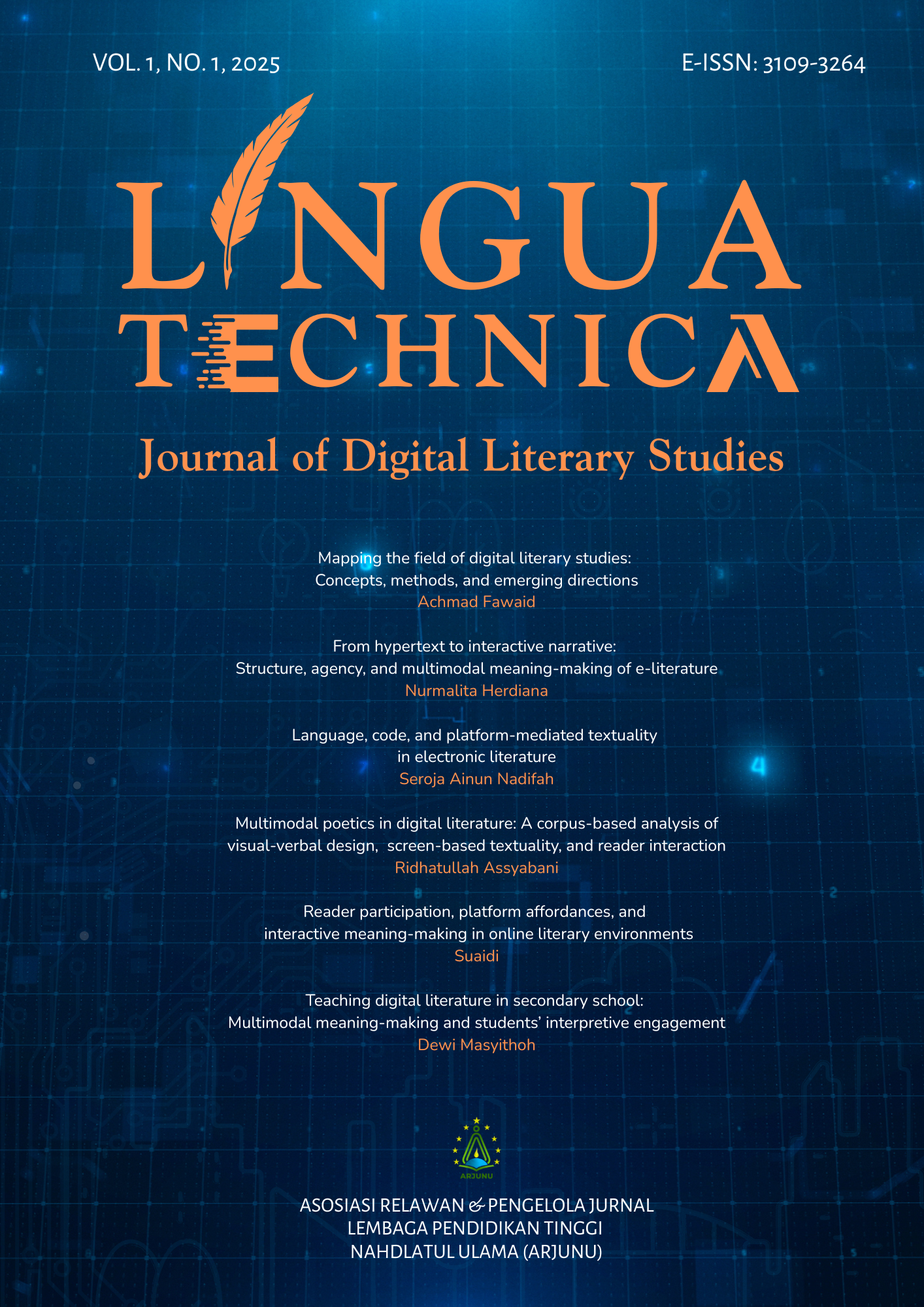
Reader participation, platform affordances, and interactive meaning-making in online literary environments
DOI:
https://doi.org/10.64595/lingtech.v1i0.147Keywords:
digital literature, interactivity, online literary environments, platform affordances, reader participationAbstract
Background: The growth of online literary environments has transformed reading from a private act of textual reception into a participatory, interactive, and platform-mediated cultural practice in which readers comment, evaluate, classify, recommend, and circulate literary works. Objective: This study aims to examine how reader participation and interactivity are constructed through the relationship among digital narrative structures, reader responses, and platform affordances in online literary environments. Method: Using a qualitative digital textual design, this study analyzes digital literary works, reader comments, votes, kudos, bookmarks, tags, author’s notes, content warnings, interface features, and participation metrics from Electronic Literature Collection, Wattpad, Archive of Our Own, and ELMCIP Knowledge Base. Results: The findings show that interactive narrative structures operate through hyperlink-based navigation, multimodal activation, serial continuation, paratextual framing, and interface-mediated reader movement. Implication: Reader responses demonstrate that literary meaning is produced through affective engagement, interpretation, evaluation, communal interaction, curation, and textual circulation. Novelty: This study contributes to digital literary studies by integrating digital narratology, reader-response analysis, and platform/interface analysis into a unified framework for understanding online literature as a socio-technical literary ecology.
Downloads
References
Alan, V. (2023). Digital Storytelling and Multimedia Tools for Teaching Language and Literature. Shanlax International Journal of English. https://doi.org/10.34293/rtdh.v12is1-dec.49
Basaraba, N., Arnds, P., Edmond, J., & Conlan, O. (2021). New Media Ecology and Theoretical Foundations for Nonfiction Digital Narrative Creative Practice. Narrative, 29, 374–395. https://doi.org/10.1353/nar.2021.0017
Bell, A., & Ensslin, A. (2024). Reading Digital Fiction: Narrative, Cognition, Mediality (p. 207). https://doi.org/10.4324/9781003110194
Chang, C.-Y., & Chu, H.-C. (2022). Mapping Digital Storytelling in Interactive Learning Environments. Sustainability. https://doi.org/10.3390/su141811499
Gaudenzi, S. (2022). Corona Haikus. Interactive Film & Media Journal. https://doi.org/10.32920/ifmj.v2i2.1587
Gil, M., & Sylla, C. (2021). A close look into the storytelling process: The procedural nature of interactive digital narratives as learning opportunity. Entertain. Comput., 41, 100466. https://doi.org/10.1016/j.entcom.2021.100466
Koenitz, H. (2023). Understanding Interactive Digital Narrative. https://doi.org/10.4324/9781003106425
Koenitz, H., Holloway-Attaway, L., & Perkis, A. (2023). Editorial: Interactive digital narratives representing complexity. 4. https://doi.org/10.3389/frvir.2023.1132785
Lisenkova, A. (2021). Digital storytelling and micro-narratives—New forms of representation of personal experience and collective creativity. 12, 45–52. https://doi.org/10.5922/2225-5346-2021-2-3
Martínez, L. (2024). MEDIA DIMENSIONS: COMPARING STORYTELLING ACROSS LITERATURE, CINEMA AND VIDEOGAME. European Journal of Literature, Language and Linguistics Studies. https://doi.org/10.46827/ejlll.v8i1.521
Metawe, D. (2024). La smart-fiction: Une fusion de technologie et d’imagination. مجلة البحث العلمي في الآداب. https://doi.org/10.21608/jssa.2024.258071.1594
Meyerhofer-Parra, R., González-Martínez, J., & Peracaula-Bosch, M. (2024). Postdigital Storytelling: Storytelling (Within or Across) the Digital and Transmedia Field. Postdigital Science and Education, 6, 886–901. https://doi.org/10.1007/s42438-024-00476-2
Nik, E., Gauci, R., Ross, B., & Tedeschi, J. (2024). Exploring the potential of digital storytelling in a widening participation context. Educational Research, 66, 329–346. https://doi.org/10.1080/00131881.2024.2362336
Palioura, M., & Dimoulas, C. (2022). Digital Storytelling in Education: A Transmedia Integration Approach for the Non-Developers. Education Sciences. https://doi.org/10.3390/educsci12080559
Rahiem, M. (2021). Storytelling in early childhood education: Time to go digital. International Journal of Child Care and Education Policy, 15. https://doi.org/10.1186/s40723-021-00081-x
Rodríguez, C. L., García-Jiménez, M., Massó-Guijarro, B., & Cruz-González, C. (2021). Digital Storytelling in Education: A Systematic Review of the Literature. Review of European Studies, 13, 13. https://doi.org/10.5539/res.v13n2p13
Rukmi, N. S., Rukminingsih, & Novianti, H. (2024). Reading digital fiction. Narrative, cognition, mediality. Media Practice and Education, 25, 302–304. https://doi.org/10.1080/25741136.2024.2352973
Trichopoulos, G., Alexandridis, G., & Caridakis, G. (2023). A Survey on Computational and Emergent Digital Storytelling. Heritage. https://doi.org/10.3390/heritage6020068
Zafar, Q., Jabeen, G., Asif, M., & Rauf, Z. (2024). Exploration of How Digital Media and Technology are Changing Narrative Forms and Literary Consumption. Bulletin of Business and Economics (BBE). https://doi.org/10.61506/01.00486
Zhang, Y., Luo, Y., & Chen, K. (2024). Digital Storytelling: Adapting Traditional Narratives to the Digital Age in English Literature. Philosophy and Social Science. https://doi.org/10.62381/p243c10
Downloads
Published
Issue
Section
License
Copyright (c) 2025 Suaidi

This work is licensed under a Creative Commons Attribution-ShareAlike 4.0 International License.



























 (CC-BY-SA 4.0).