
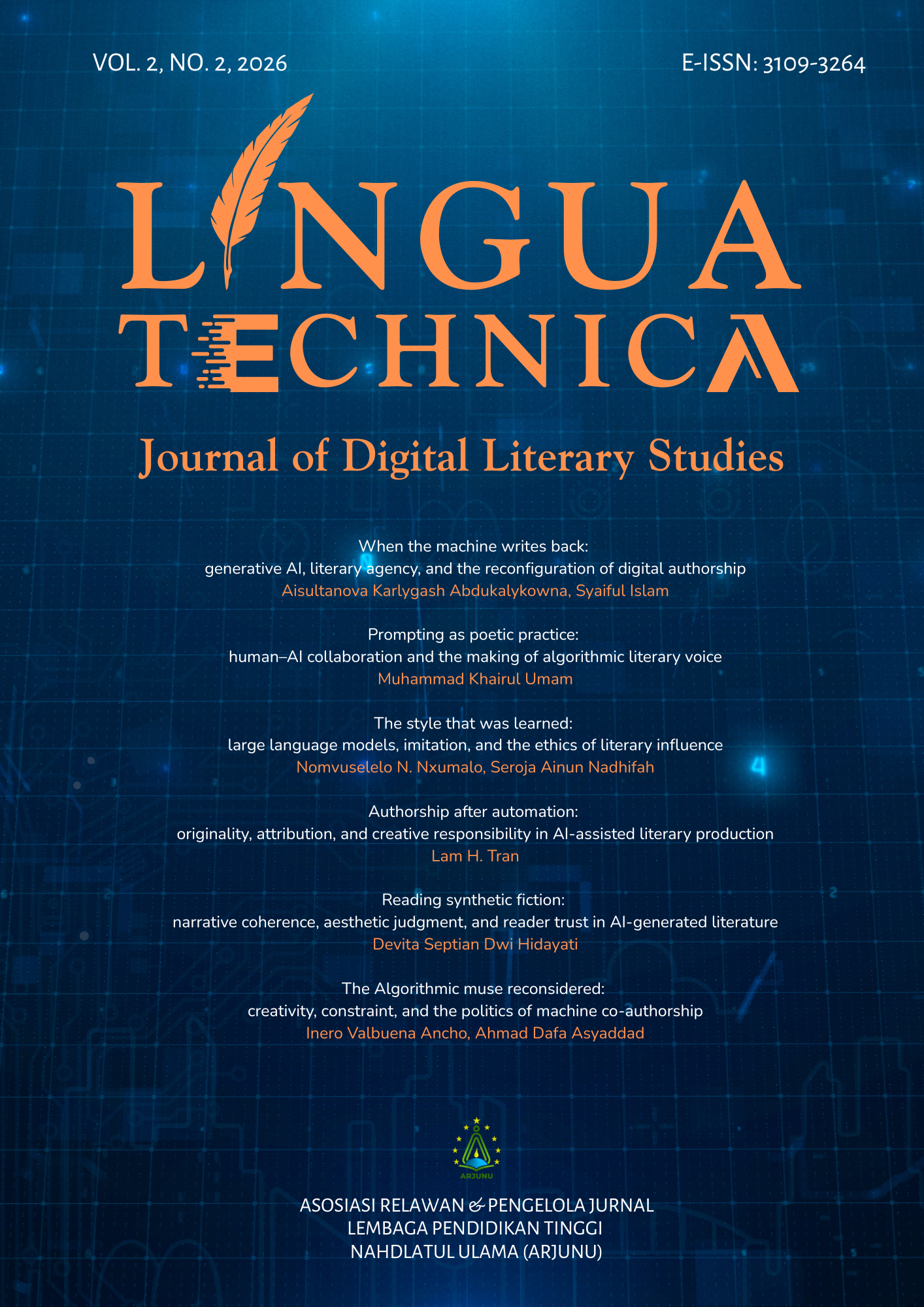
Algorithmic muse reconsidered: creativity, constraint, and the politics of machine co-authorship
DOI:
https://doi.org/10.64595/2h40cg81Keywords:
Algorithmic authorship, Creative constraints, Human–AI co-creativity, Machine co-authorship, Platform governanceAbstract
Background: Generative artificial intelligence has transformed literary production across publishing, education, cultural industries, and digital platforms while intensifying disputes over creativity, attribution, ownership, accountability, and platform power. Objective: This study examines how creative agency, constraint regimes, and authorship governance are configured across contemporary machine co-authorship discourse and what these configurations reveal about institutional legitimacy. Method: Using qualitative comparative documentary analysis, this study coded forty publicly accessible records comprising thirteen primary documents, seventeen secondary sources, and ten contextual materials published or current between 2021 and 2026 through explicit decision rules and evidence notes. Results: Creative agency was most frequently represented as an integrated human–machine–platform chain combining initiation, prompting, generation, revision, and mediation. Institutional constraints dominated the corpus, while aesthetic, technical, legal, economic, and data-related conditions operated as enabling, limiting, or simultaneously ambivalent forces. Human accountability and platform power were substantially more prevalent than contractual output ownership, indicating that creative participation, legal authorship, and institutional control remain unevenly distributed. Implication: Legitimate machine co-authorship requires transparent contribution, proportionate attribution, human editorial responsibility, accountable training practices, and governance capable of protecting creative diversity. Novelty: This study contributes an integrated framework that connects distributed agency, creativity-under-constraint, and authorship politics within a single document-level analytical architecture.
Downloads
References
Ahuja, T., Dey, H. S., & Dutt, S. (2025). Autonomy, authenticity, authorship and intention in computer generated art. International Journal of Science and Research. https://doi.org/10.21275/sr25204123429
Ali, S., Ghose, A., Saurav, S., Deshmukh, S. N., Hart, R., Olewitz, C., & Japanese, A. (2024). Creativity and innovation in the age of artificial intelligence: A copyright dilemma. PADJADJARAN Jurnal Ilmu Hukum (Journal of Law). https://doi.org/10.22304/pjih.v11n2.a1
Amazon Kindle Direct Publishing. (n.d.). Content guidelines: Artificial intelligence content. Retrieved July 11, 2026, from https://kdp.amazon.com/help/topic/G200672390
Anthropic. (2023, December 19). Expanded legal protections and improvements to our API. https://www.anthropic.com/news/expanded-legal-protections-api-improvements
Authors Guild. (2023, July 18). Thousands sign Authors Guild letter calling on AI industry leaders to protect writers. https://authorsguild.org/news/thousands-sign-authors-guild-letter-calling-on-ai-industry-leaders-to-protect-writers/
Authors Guild. (2024, February 29). Authors Guild releases AI best practices for authors. https://authorsguild.org/news/authors-guild-releases-ai-best-practices-for-authors/
Benbya, H., Strich, F., & Tamm, T. (2024). Navigating generative artificial intelligence promises and perils for knowledge and creative work. Journal of the Association for Information Systems, 25, 13. https://doi.org/10.17705/1jais.00861
Burkhardt, S., & Rieder, B. (2024). Foundation models are platform models: Prompting and the political economy of AI. Big Data & Society, 11. https://doi.org/10.1177/20539517241247839
Elsevier. (n.d.). Generative AI policies for journals. Retrieved July 11, 2026, from https://www.elsevier.com/about/policies-and-standards/generative-ai-policies-for-journals
Elsevier. (n.d.). The use of generative AI and AI-assisted technologies in writing for Elsevier. Retrieved July 11, 2026, from https://www.elsevier.com/about/policies-and-standards/the-use-of-generative-ai-and-ai-assisted-technologies-in-writing-for-elsevier
European Union. (2024). Regulation (EU) 2024/1689 of the European Parliament and of the Council of 13 June 2024 laying down harmonised rules on artificial intelligence. Official Journal of the European Union. https://eur-lex.europa.eu/eli/reg/2024/1689/oj/eng
Fritz, J. (2025). Understanding authorship in artificial intelligence-assisted works. Journal of Intellectual Property Law & Practice. https://doi.org/10.1093/jiplp/jpae119
Garcia, M. (2024). The paradox of artificial creativity: Challenges and opportunities of generative AI artistry. Creativity Research Journal, 37, 755–768. https://doi.org/10.1080/10400419.2024.2354622
Grilli, L., & Pedota, M. (2024). Creativity and artificial intelligence: A multilevel perspective. Creativity and Innovation Management. https://doi.org/10.1111/caim.12580
Gunkel, D. J. (2025). Prompted by me. Generated by ChatGPT. Human-Machine Communication. https://doi.org/10.30658/hmc.10.2
Heimstad, S. B., Wien, A., & Gaustad, T. (2025). Machine heuristic in algorithm aversion: Perceived creativity and effort of output created by or with artificial intelligence. Computers in Human Behavior: Artificial Humans, 5, 100190. https://doi.org/10.1016/j.chbah.2025.100190
Huang, H.-C. (2025). Unlocking creativity with artificial intelligence: Field and experimental evidence on the Goldilocks effect of human–AI collaboration. Journal of Experimental Psychology: General. https://doi.org/10.1037/xge0001838
Hutson, J. (2025). Human–AI collaboration in writing: A multidimensional framework for creative and intellectual authorship. International Journal of Changes in Education. https://doi.org/10.47852/bonviewijce52024908
Jago, A. S., & Carroll, G. R. (2023). Who made this? Algorithms and authorship credit. Personality and Social Psychology Bulletin, 50, 793–806. https://doi.org/10.1177/01461672221149815
Kalhor, G., Ali, S., & Mashhadi, A. (2025). Measuring biases in AI-generated co-authorship networks. EPJ Data Science, 14. https://doi.org/10.1140/epjds/s13688-025-00555-9
Komura, K., & Yamada, S. (2026). Deepening ideas versus exploring new ones: AI strategy effects in human–AI creative collaboration. PLOS ONE, 21, e0340449. https://doi.org/10.1371/journal.pone.0340449
Lim, J., Leinonen, T., Lipponen, L., Lee, H., DeVita, J., & Murray, D. (2023). Artificial intelligence as relational artifacts in creative learning. Digital Creativity, 34, 192–210. https://doi.org/10.1080/14626268.2023.2236595
Lund, B. D., & Naheem, K. T. (2023). Can ChatGPT be an author? A study of artificial intelligence authorship policies in top academic journals. Learned Publishing, 37. https://doi.org/10.1002/leap.1582
McGuire, J., De Cremer, D., & Van De Cruys, T. (2024). Establishing the importance of co-creation and self-efficacy in creative collaboration with artificial intelligence. Scientific Reports, 14. https://doi.org/10.1038/s41598-024-69423-2
Messer, U. (2024). Co-creating art with generative artificial intelligence: Implications for artworks and artists. Computers in Human Behavior: Artificial Humans, 2, 100056. https://doi.org/10.1016/j.chbah.2024.100056
OpenAI. (2022, November 14). Sharing & publication policy. https://openai.com/policies/sharing-publication-policy/
OpenAI. (2026, January 1). Terms of use. https://openai.com/policies/row-terms-of-use/
Shi, Y., Gao, T., Jiao, X., & Cao, N. (2023). Understanding design collaboration between designers and artificial intelligence: A systematic literature review. Proceedings of the ACM on Human-Computer Interaction, 7, 1–35. https://doi.org/10.1145/3610217
Society of Authors. (n.d.). Artificial intelligence. Retrieved July 11, 2026, from https://societyofauthors.org/where-we-stand/artificial-intelligence/
Society of Authors. (2026, March 11). Human Authored scheme launched as generative AI threatens authors’ livelihoods. https://societyofauthors.org/2026/03/11/human-authored-scheme-launched-as-generative-ai-threatens-authors-livelihoods/
Subagiyo, D. T., & Wibisono, H. (2025). The urgency of artificial intelligence regulation from a joint authorship perspective on copyright infringement. Indonesia Private Law Review. https://doi.org/10.25041/iplr.v5i2.3962
Tromp, C. (2022). Integrated constraints in creativity: Foundations for a unifying model. Review of General Psychology, 27, 41–61. https://doi.org/10.1177/10892680211060027
Tsao, J., & Nogues, C. (2024). Beyond the author: Artificial intelligence, creative writing and intellectual emancipation. Poetics. https://doi.org/10.1016/j.poetic.2024.101865
U.S. Copyright Office. (2023, March 16). Copyright registration guidance: Works containing material generated by artificial intelligence. https://www.copyright.gov/ai/ai_policy_guidance.pdf
U.S. Copyright Office. (2025, January 29). Copyright and artificial intelligence, Part 2: Copyrightability. https://www.copyright.gov/newsnet/2025/1060.html
Vinchon, F., Lubart, T., Bartolotta, S., Gironnay, V., Botella, M., Bourgeois-Bougrine, S., Burkhardt, J.-M., Bonnardel, N., Corazza, G., Glăveanu, V., Hanson, M. H., Ivcevic, Z., Karwowski, M., Kaufman, J., Okada, T., Reiter-Palmon, R., & Gaggioli, A. (2023). Artificial intelligence and creativity: A manifesto for collaboration. The Journal of Creative Behavior. https://doi.org/10.1002/jocb.597
Writers Guild of America West. (2026, April 24). 2026 MBA contract changes FAQ. https://www.wga.org/contracts/contracts/mba/2026-mba-contract-changes-faq
Xiao, Y. (2022). Decoding authorship: Is there really no place for an algorithmic author under copyright law? International Review of Intellectual Property and Competition Law, 54, 5–25. https://doi.org/10.1007/s40319-022-01269-5
Zhang, C., Shao, Y., Yuan, Y., & Shen, W. (2025). Artificial intelligence reshapes creativity: A multidimensional evaluation. PsyCh Journal, 14, 831–840. https://doi.org/10.1002/pchj.70042
Downloads
Published
Issue
Section
License
Copyright (c) 2026 Inero Valbuena Ancho, Ahmad Dafa Asyaddad

This work is licensed under a Creative Commons Attribution-ShareAlike 4.0 International License.

















 Creative Commons Attribution 4.0 International License